A checklist for preventing runner's knee pain
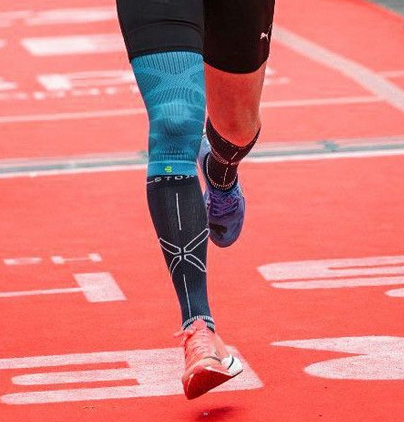 A brief list of things to check in order to prevent runner's knee pain
(based on a personal experience of a 10x marathoner, find the strava profile here). The list should not be considered complete, it only represents the personal perspective.
A brief list of things to check in order to prevent runner's knee pain
(based on a personal experience of a 10x marathoner, find the strava profile here). The list should not be considered complete, it only represents the personal perspective.
So, here are some important items to pay attention to.
-
Did rapid increases in the training volume or intensity happen recently? When workout volume or intensity are increased too quickly, it might result to overuse injuries. Increasing running mileage or speed too quickly puts extra pressure on the muscles, tendons, and ligaments which protect the knee. In that case, build up the load gradually at the right pace, and, perhaps, consider taking more time to recover properly.
-
Check the proportion of your easy runs and the speed work. High-intensity training like sprinting or hill work puts an increased stress on the patellar tendon. Too much of these kinds of running without proper rest can cause irritation or inflammation of the tendon. Cumulative load and muscles fatigue during slow, long-distance runs can add more pressure on the knees as well.
For optimal knee health and injury prevention, a training split of approximately 80% slow/easy runs and 20% high-intensity/speed work is usually recommended. -
Were there any other recent injuries or issues not directly related to knees, like lateral ankle sprains, or maybe lower back pain? The root cause of the knee pain might be actually hidden in some other parts of the body, so it might be easily overlooked. Were there any other recent injuries or issues not directly related to knees, like lateral ankle sprains, or maybe lower back pain? The root cause of the knee pain might be actually hidden in some other parts of the body, so it might be easily overlooked. Even a minor pain or discomfort can result to changes in running gait, so that the body unconciously tries to minimize the discomfort by applying some unnatural positions. It might be excessive leaning of the landing foot, or a lateral pelvis tilt. These kind of conditions can impact the knees.
-
Check your running style. While not inherently bad, excessive heel striking can load the knees more than necessary, and it's usually caused by overstriding (landing the foot too far ahead of the knee and centre of mass). It results into high braking forces, which act as a shockwave, and send excessive impact stress directly to the knee joints. Maybe, consider increasing the cadence instead of stride length. Running with a quicker step rate is one of the easiest tweaks one can make to prevent overstriding.
-
Do you perform a sufficient volume of strength workout? Regular squats is a must, also split squats, bulgarian split squats, forward lunges, reverse lunges, single leg bridges do a great job as well.
-
Do you perform mobility and stretching exercises? The lateral (a.k.a side) lunge is really a high-value thing to do. Deep lunges, pigeon hold - actually, there's a whole bunch of useful exercises which can improve the state of the knees.
-
Check your shoes. IT Band Syndrome (a.k.a Iliotibial band syndrome) might be caused by instability coming from the shoes, which forces the knee to twist and results to irritation of the tendon. Both too bouncy (excessively cushioned) and unstable running shoes can contribute to knee pain during prolonged running exercises. Also, old or worn-out shoes might lose their cushioning and structural integrity. Midsole foam deforms and compresses over time, and uneven deformation under the toes and heel can cause the runners to modify their gait to compensate for the loss of stability and cushioning. Also, such worn-out shoes can no longer absorb impact, which forces the knees to work harder. A typical recommendation is to replace running shoes every 500 to 800 kilometers, depending on the model. Foam requires 24-48 hours to fully recover from compression, so rotating shoes can prolong their life. Before buying new shoes, keep in mind the specific purpose of your running shoes. Find some reviews to learn if the selected model fits to this purpose.
-
Do you sleep enough? Deep sleep releases growth hormones needed for building and repairing bones, muscles and tissues. Lack of sleep means that the body doesn't release enough hormones to support tissues recovery and repair.
-
Is your hydration sufficient during a workout? Water is crucial for maintaining the structure of cartilage that cushions the joints. Cartilage consists of nearly 70–80% water, which allows it to reduce friction and enable smooth movement. When dehydrated, cartilage can become more prone to irritation or even deterioration. Therefore, a lack of hydration can contribute to joint pain, especially in a hot environment.
-
Is your diet healthy enough? A lack of key nutrients, vitamins, and minerals in a diet might worsen knee pain. Make sure that intake of proteins is sufficient. Vitamin C is also crucial for the synthesis of collagen, a protein that helps wound healing and maintains the health of skin, cartilage, teeth, bones, etc. Calcium, magnesium are among the essentials as well. Vitamin D is needed for calcium absorption and maintaining proper bone density. Supplements can be an efficient way to add lacking elements. Still, supplements are not a silver bullet.
-
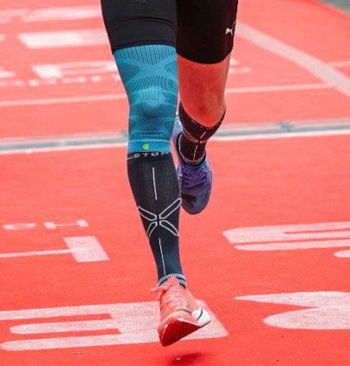
What about knee compression sleeves? They can provide additional support for the knees, as a temporary measure.
-
If the knee pain continues, visiting a physiotherapist for getting a qualified help might be a good idea. In case of a severe pain, it's highly recommended to consult a doctor and get a professional medical advice.
Disclaimer: This post is intended for informational and educational purposes only, it's not a substitute for professional medical advice, diagnosis, or treatment.