Another day, another run. 20 km this time
This one felt a little bit easier than a 25km run the day before, probably due to lighter and bouncier shoes. Light conditions were also somewhat better, street lights were present practically everywhere along the route.
The same way, the data were taken from the .tcx file exported from Garmin Connect. But this time, there was something unexpected in the plot that shows a distribution of different elevation profiles. The numbers (~8km totally flat, approx. 4 km of a slight incline and 4 km of a mild decline) looked pretty convincing, except of small portions of the run marked as "> 20% uphill" and "> 20% downhill". This kind of terrain with more that 20% of grade would be definitely noticeable, however, in reality it simply wasn't true, there were no such steep sections there.
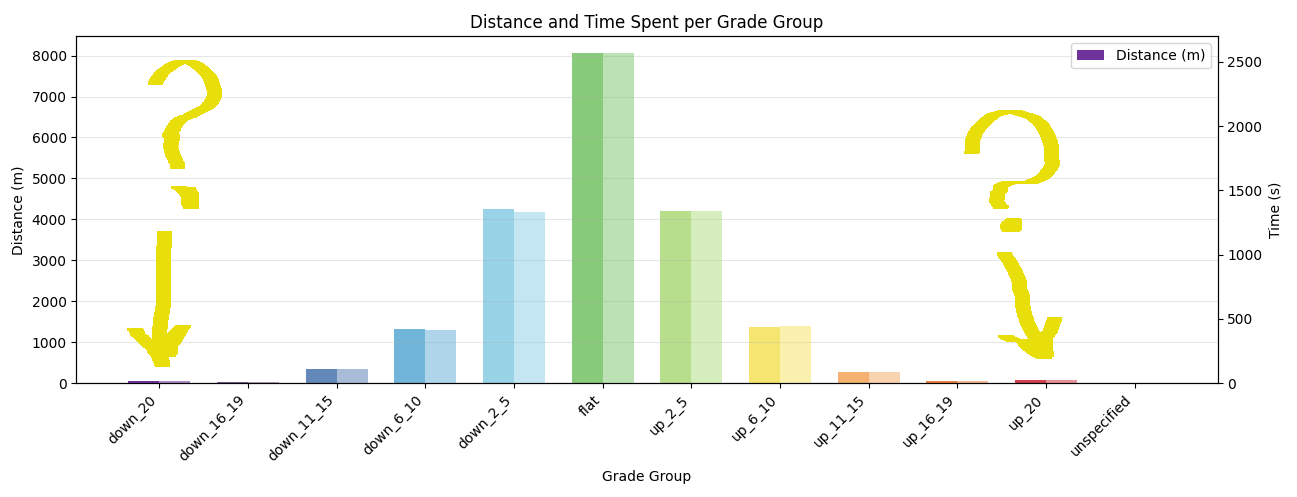
To solve this mystery, the second plot came into the play. It showed the elevation and the grade over the distance simultaneously, and actually helped to reveal the reason of having these crazy uphill and downhill sections in the first plot.
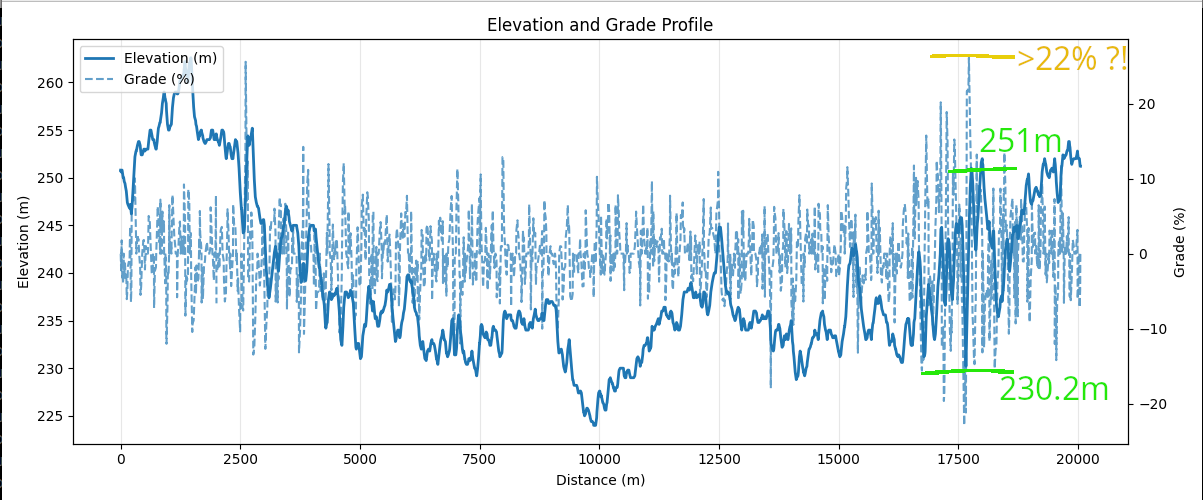
It appeared that there was a rapid fluctuation of elevation values in the raw data, with a jump from 230m to 251m. 21m of elevation gain in just one hundred meters of distance would probably feel like running onto the top of a 6-store building, which didn't make any sense in that particular part of the route.
But, this part of the route had no trees or buildings and was pretty open to wind. Given that my Garmin device uses a barometric altimeter as an elevation sensor, it's pretty likely that this fluctuation was caused by a wind gust. Interestingly, Strava app, which imported the same workout, filtered this fluctuation out.
So, that was a useful exercise, the lesson learned - don't blindly trust the raw data, they might be just incomplete. There are so many factors which might affect the workout, it makes running outdoors even more exciting. Stay tuned, keep moving!