How to run uphill: focus on cadence (Wolfsbuck hill run on Feb 05)
To give some context, Wolfsbuck (273m above sea level) is a hill in Freiburg, Germany. The prominence is not that high, just 35m, still, it's a very good place to run because it's located practically within the city, the trails are well-maintained, and it's comfortably reachable on foot even during a lunch break. The views are also good, maybe we'll take some pictures next time.
Back to uphill running - the common recommended approach is usually to increase the cadence and shorten the stride length, which is significantly better than taking longer strides. To confirm this with the data, some plots were built based on the .tcx file from Strava.
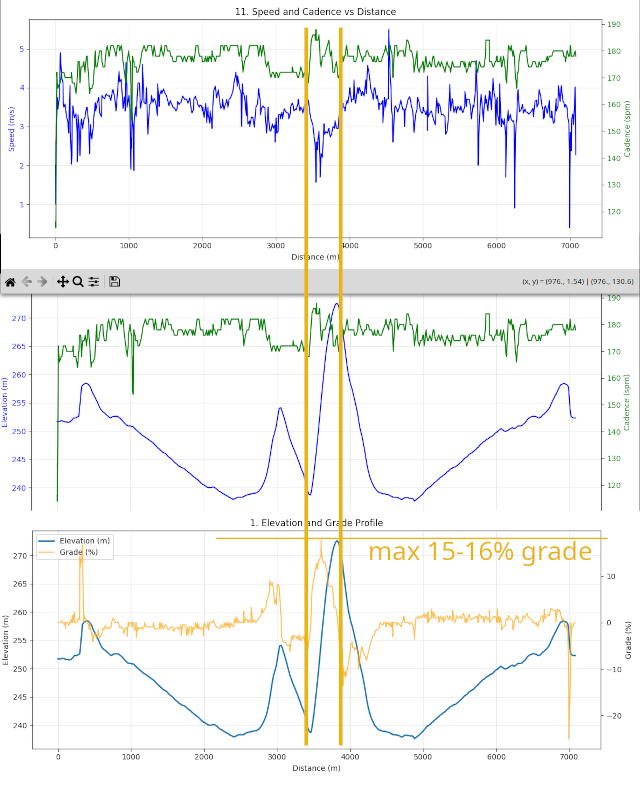
A section between the left and the right vertical orange lines is basically the trail leading to the top of the hill. As it can be seen from the highest plot, the speed dropped significantly in the steepest part, which is kind of expected, because the elevation grade reaches up to 15-16% there. The green line shows that the cadence grew to 185 spm, and started to decline when the highest grade had been passed. Given higher cadence and lower speed, it means that the stride length got much smaller on the steep ascend than on the flat road.
So, now we can say that "increase your cadence" statement really makes sense for uphill runs. Of course, just one run on a 35-m hill is still not really a huge source of data, still, it shows that the recommended approach is reasonable and it actually works. And, of course, more insights on uphill running are to be collected in the next workouts. Stay tuned!