Running steep heels: what is optimal stride length? Run on Feb 6
The topic of hills running was briefly touched on in one of the previous posts, this time we are going to compare the data from steep uphill and downhill sections route sections of a 20 km run.
The data were taken both from Garmin and Strava, it's always interesting to compare. The steepest part of the route is a hill with approximately 40m of elevation gain, located in Heuweiler near Freiburg. The place is really scenic, the pictures (hopefully) will come in the next posts.
Elevation grade reaches up to 14% at the steepest parts, it's definitely not the highest value ever, the route is still runnable. However, this kind of grade feels different compared to a flat route, and running style requires some adjustments.
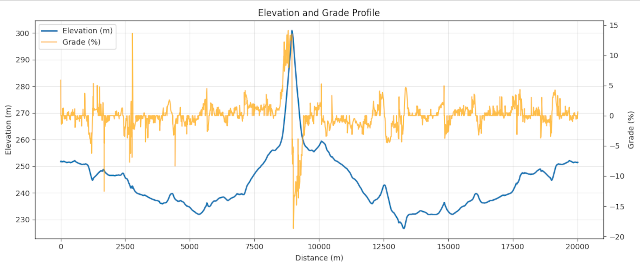
As it can be seen from the plot (Strava-based data),
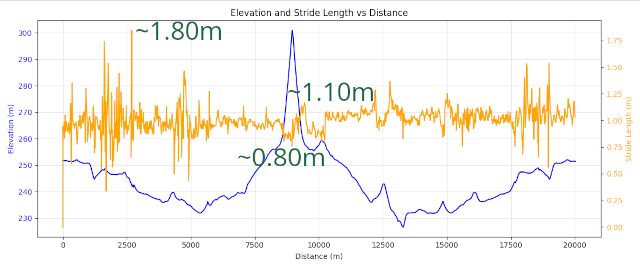
at the steepest uphill part stride length gets much smaller. In this particular case it's something around 0.8m with 10-14% grade. That's totally expected, because longer strides require more energy while running uphill, due to performing mechanical work against gravity. Of course, a trained trail runner could have somewhat longer stride length with the same grade, but we are going to be realistic. What is not obvious here, is that the approximate 1.10m stride length in the steepest downhill is just a little bit higher. And, it's very far from being the highest value in this run. The reason is that very long strides in that kind of slope would cause excessive braking forces and, possibly, some kind of knee pain due to increased impact (again, it's not a case of a trained trail runner).
So, the conclusion - stride length may vary a lot in flat parts of route, but in very steep slopes it might be a good idea to decrease stride length a bit and maintain the desired speed by adjusting cadence.
There's plenty of nice hills nearby, so we're going to bring more data- and experience-backed details on this topic in the next posts. Stay tuned!